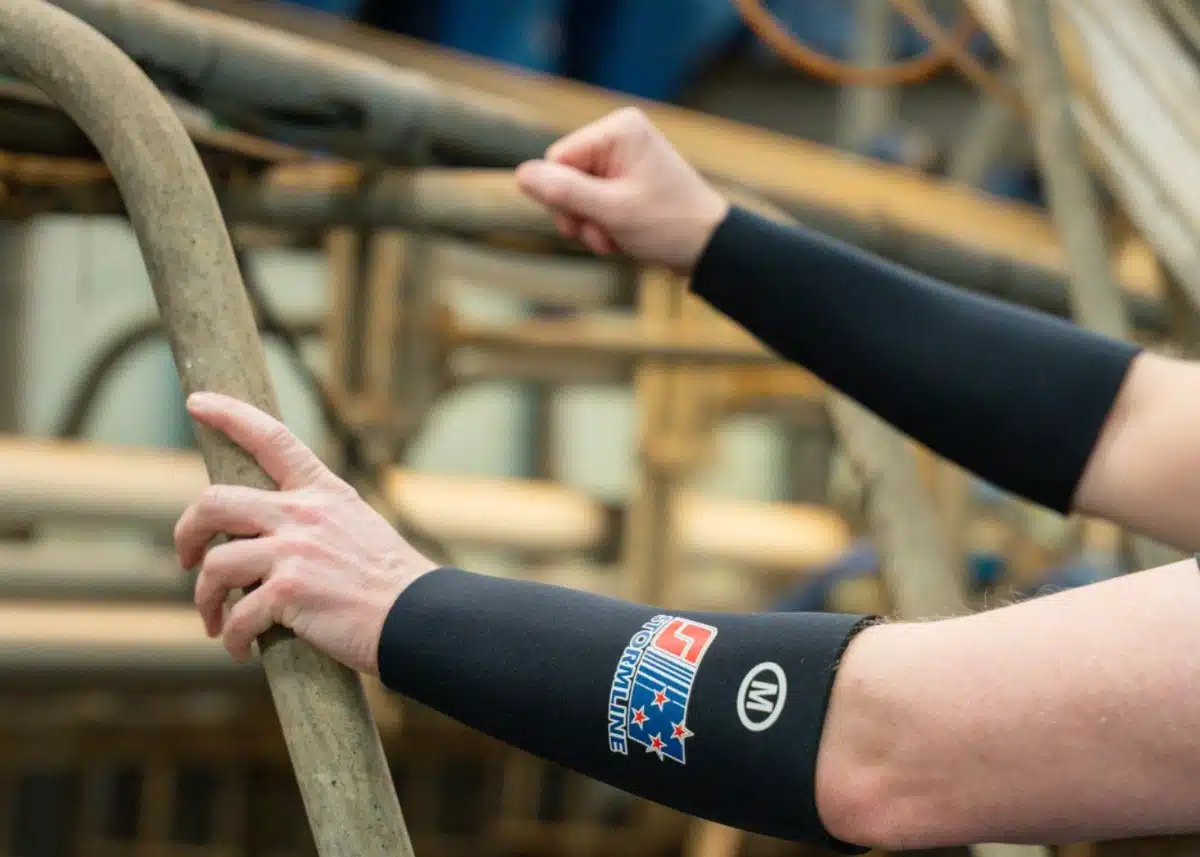
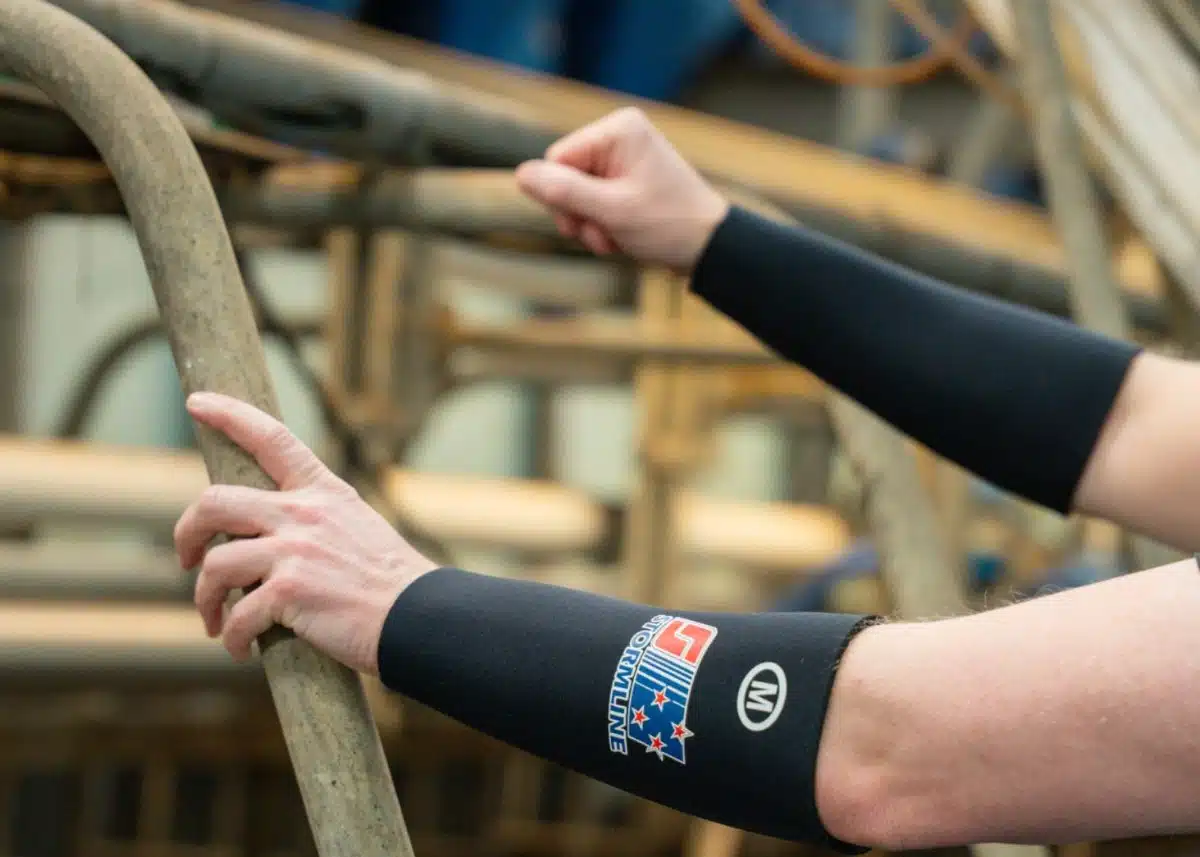
N001 4mm neoprene sleeves in a working milking parlour.
Dairy parlour clothing has a harder life than most workwear. There are two milkings a day, a hose running for a good part of each one, and parlour detergent and teat dip splashing at chest height. In winter the parlour may only be a few degrees above freezing when the first cows come in. A cheap apron or a thin neoprene sleeve that would be fine for a weekend job usually gives up within weeks.
Stormline started in New Zealand in 1966 and has been making heavy-duty PVC waterproofs for wet, cold work ever since. This guide covers what we would put on a milker, whether you call it a milking parlour in the UK or a milking parlor in the US: a heavy PVC apron, the right arm sleeves, a jacket for washdown, and how to keep the lot clean.
Dairy parlour picks at a glance
Most milkers are covered by the 999HWST apron, a pair of N001 neoprene sleeves or Stormtex-Air 230 PVC milking sleeves, the 220G jacket for washdown, and either the 664G bib overalls or the 755G overtrousers on the legs. More detail on each, and the alternatives, further down.
What to wear in the milking parlour
A milker needs a heavy PVC apron from chest to shin, sleeves that close at the wrist, a waterproof top for washdown, and wellies with waterproof trousers worn over the boot. Every piece should hose clean in seconds and stay flexible in a cold parlour.
- Milking apron: takes the direct splash from the udder, the cluster and the hose. Heavy PVC lasts far longer than a disposable apron.
- Arm sleeves: neoprene for warmth and support, PVC for a dry seal. More on choosing between them below.
- Milking jacket: covers shoulders and back during washdown, when an apron alone leaves you exposed.
- Bib overalls or overtrousers, and wellies: wear the 664G bib or 755G overtrousers outside the boot so water runs off the leg and not down into the wellies.
Comfort matters as much as protection. A milking can run for two or three hours, and gear that pulls on the neck, rubs at the wrist or goes stiff in the cold gets taken off halfway through. Hygiene is the other reason to choose well: a smooth PVC surface rinses clean between milkings, while fabric and worn-out aprons hold milk residue.
Milking aprons: PVC weight, chemical resistance and strap styles
A good milking apron is heavy enough not to tear on a stall rail, resists milk fat and parlour chemicals, and stays comfortable for a full milking. For most UK and US dairies our pick is the 999HWST, a 500gsm fat-resistant PVC apron with cross-back straps that take the weight off your neck.
Heavy PVC aprons vs disposable aprons
Thin disposable aprons are cheap per piece, but a parlour can get through a lot of them, and they tear on cluster hooks and rails. Our heavy-duty PVC aprons are 500gsm or 650gsm, which is heavy enough to shrug off that kind of wear and be hosed down and reused milking after milking. Fewer aprons in the bin also means less plastic waste.
Weight is only half of it. Low-grade PVC goes stiff when the temperature drops and starts cracking at the folds. Our PVC is lab tested to stay flexible down to −25°C / −13°F, so a Stormline apron left hanging in an unheated parlour overnight is still soft for the morning milking.
Resistance to milk fat and parlour chemicals
Milk fat breaks down cheap plastics over time, and so does daily contact with detergent and teat dip. The 999HWST apron is made from oil- and fat-resistant PVC that is resistant to dairy sanitising chemicals, and it can be power washed. The 999ST and 999HW aprons are both made from oil-resistant PVC.
Cross-back straps, neck straps or braces
Strap style is the thing milkers notice most by the end of a shift. Cross-back (X-strap) PVC aprons such as the 999HWST spread the load over both shoulders instead of hanging it from the neck. The 999ST uses wide elastic braces with adjustable clips, which suits anyone who wants the apron to move with them. The 999HW has sewn PVC neck and waist ties for a quick on and off.
| Apron | PVC weight | Straps | Size | Cut to length? |
|---|---|---|---|---|
| 999HWST | 500gsm oil- and fat-resistant | Cross-back PVC straps, stainless eyelets | 1.2m × 90cm (47in × 35in) | Yes |
| 999ST | 650gsm oil-resistant (our heaviest) | 38mm elastic braces with adjustable clips | 1.2m × 90cm (47in × 35in) | No |
| 999HW | 500gsm oil-resistant | Sewn PVC neck and waist ties | 1.2m × 90cm (47in × 35in) | Yes |
All three are one size and can be trimmed where shown. Prices show in £ GBP or $ USD depending on where you are browsing from.
Neoprene sleeves vs PVC sleeves: protecting your forearms
A neoprene sleeve keeps the forearm warm and supported, while a PVC milking sleeve keeps it dry. The N001 4mm neoprene sleeve suits cold parlours and long milkings; a PVC sleeve with a latex cuff is the better seal when you are working in heavy spray.
4mm neoprene arm sleeves (N001)
The N001 4mm neoprene protective sleeves are made from high-density 4mm neoprene with stitched, glued and taped seams. The 4mm neoprene arm sleeve insulates the forearm against cold water, so hands and wrists do not chill as quickly on a winter morning. A snug, watertight wrist seal stops water running inside, and the shaped fit keeps the sleeve in place instead of sliding down every time you reach for a cluster.
That snug fit also gives light compression around the forearm through a long run of cup attachment. The N001 sleeves fit over gloves or under a jacket cuff, and come as a pair in sizes S to 2XL. If you want more feel and less bulk, the N002 3mm neoprene sleeves are thinner and more flexible, with stitched and glued seams.
PVC milking sleeves (Stormtex-Air 230)
The Stormtex-Air 230 milking sleeve is made from 340gsm oil- and chemical-resistant PVC with double-welded seams and a welded latex wrist cuff. The latex cuff closes around the wrist, so spray from the clusters and the hose runs off instead of creeping up the arm. The Stormtex-Air 230 PVC sleeves are sold as a pair in M, L and XL and are made for rotary and herringbone parlours.
Which sleeve to choose
| Sleeve | Material | Seams | Wrist | Sizes | Best for |
|---|---|---|---|---|---|
| N001 | 4mm high-density neoprene | Stitched, glued and taped | Snug watertight seal | S–2XL (pair) | Cold parlours, long milkings, forearm support |
| N002 | 3mm neoprene | Stitched and glued | Snug fit | S–2XL (pair) | Warmer parlours, more feel |
| Stormtex-Air 230 | 340gsm PVC | Double-welded | Welded latex cuff | M, L, XL (pair) | Heavy spray, rotary and herringbone parlours |
N001 wrist sizes run from 15cm (S) to 20cm (2XL). If you are between sizes, go up one.
Milking jackets and top-half protection
During washdown the spray comes from every direction, and an apron does nothing for your shoulders and back. A waterproof milking jacket with cuffs that close around the wrist stops water running up your arms when you lift the hose.
The Stormtex-Air 220G farming jacket is our milking jacket for this job. The 220G jacket is made from 340gsm PVC with a PU coating that keeps it supple, and the PVC is oil-resistant. Neoprene cuffs seal at the wrist, and the drawstring hood adjusts to stay up when you are hosing down overhead. Like all our PVC gear, the seams are double-welded rather than stitched, so there are no needle holes for water to find.
If you were looking for a waterproof apron with sleeves, a heavy PVC apron worn with a pair of PVC milking sleeves does the same job. It also means a worn sleeve can be replaced on its own without buying a whole new garment.
Waterproof bib overalls and overtrousers
An apron covers the front, but washdown water still runs down the back of the legs and into the wellies. A pair of PVC bib overalls or overtrousers worn over the boot keeps the legs dry for the whole milking.
Stormtex-Air 664G bib overalls
The Stormtex-Air 664G bib overalls are made from stretch PVC with a PU coating, and the PVC is oil-resistant. The thighs and knees are reinforced with a double layer of PVC, and the seams are double-welded. An elastic waist with a low back, 38mm elastic braces with industrial clips, an internal chest pocket and stainless steel snaps at the ankle make the 664G bib a practical piece of milking parlour clothing. The 664G is designed to be worn with the 220G jacket.
Stormtex-Air 755G overtrousers
The Stormtex-Air 755G overtrousers are lighter, at 700g, and made from 340gsm stretch PVC with a PU coating and a polyester backing that dries quickly. The 755G overtrousers have an elastic waist with a built-in belt, side pocket access to the trousers underneath, double-layer PVC on the thighs and knees, and snaps at the hem to stop water getting into your wellies. If you already wear an apron, the 755G overtrousers are the lighter way to keep your legs dry.
Cleaning, hygiene and maintenance
Rinse PVC aprons and sleeves with clean water at the end of every milking, before milk fat and detergent dry on. Neoprene sleeves need a fresh-water rinse and time to dry right through before the next milking.
PVC aprons, sleeves and jackets
- Hose the apron down from the top while you are still wearing it, then take it off and rinse the back and the straps.
- If milk fat has built up, wash the PVC apron with warm water and a mild detergent, then rinse. The 999HWST can also be power washed.
- Hang PVC aprons and jackets by the straps or a hanger, not folded, and keep them away from heaters and direct sun.
- Check the straps, eyelets and the hem every few weeks. The 999HWST and 999HW can be trimmed shorter if the bottom edge gets worn.
Neoprene sleeves
- Rinse N001 and N002 neoprene sleeves inside and out in clean water after each milking.
- Squeeze the water out rather than wringing, which stretches the neoprene.
- Hang the neoprene sleeves to dry somewhere airy, out of direct sun and off the heater, and turn them inside out so the lining dries too.
- If you milk twice a day, a second pair of neoprene sleeves means you always start with a dry pair.
Buying dairy parlour clothing in the UK and US
Prices on our site show in your local currency, so UK visitors see £ GBP and US visitors see $ USD. You can see the full range, including aprons, sleeves and jackets, in our dairy and milking parlour clothing category.
Frequently asked questions
How do I clean 4mm neoprene milking sleeves?
Rinse the N001 neoprene sleeves inside and out with clean water after each milking, squeeze them out and hang them up to dry. Keep neoprene sleeves away from heaters and strong sun, as heat hardens neoprene.
Why does cheap PVC crack in cold parlours?
Thin, low-grade PVC stiffens as the temperature drops, and the folds at the waist and straps crack after weeks of bending. Our PVC is lab tested to stay flexible down to −25°C / −13°F, so a Stormline apron stays soft in an unheated parlour.
Should I choose a cross-back or neck-strap milking apron?
A cross-back apron like the 999HWST spreads the weight over both shoulders, which takes the strain off your neck during a long milking. A neck-strap apron like the 999HW is quicker to put on and take off and suits shorter jobs or aprons shared between staff.
What size N001 neoprene sleeve should I order?
Measure around your wrist: the N001 neoprene sleeve fits wrists up to 15cm (S), 16cm (M), 18cm (L), 19cm (XL) and 20cm (2XL). If you are between sizes, order the size up.
Kitting out a dairy team?
We supply farms, dairy contractors and dealers on wholesale terms. Send us the sizes and quantities you need, or log in to the wholesale store.