
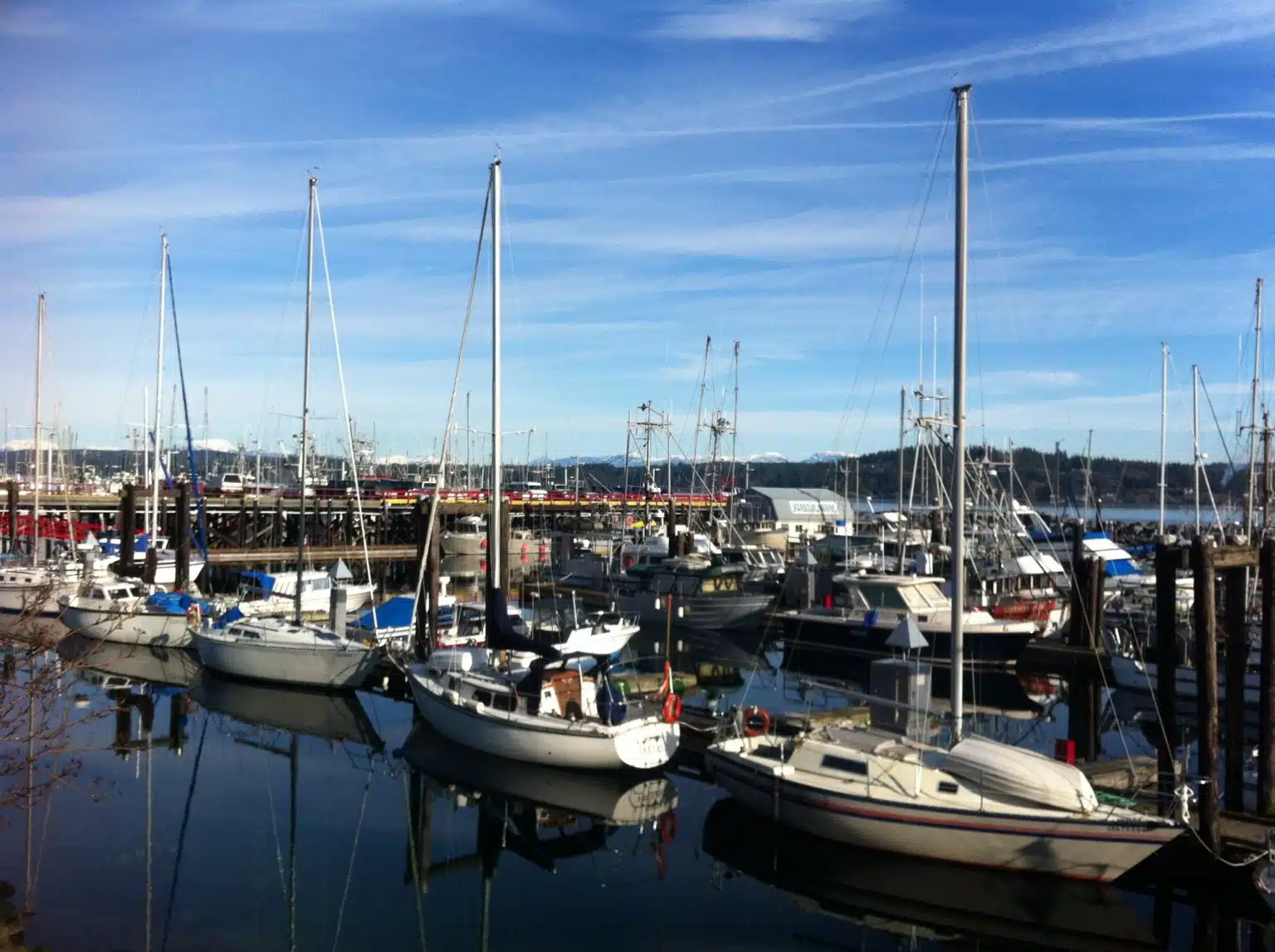
The harbour at Nanaimo, British Columbia.
Rain gear for outdoor work in Canada has a lot to deal with. On the BC coast it can rain for weeks. In Alberta the mornings start well below zero, and Ontario winters bring sleet and slush. Our PVC jackets, bibs and rain suits are fully waterproof, with double-welded seams, and stay flexible down to −25°C. They are made in Europe, shipped across Canada from our warehouse in Dartmouth, Nova Scotia, and sold in store on Vancouver Island.
Canadian job-site picks at a glance
Most crews are covered by one of three rain suits: the 650gsm Crew suit for the wettest jobs, the 500gsm Stormtex suit for everyday site work, and a neon yellow suit for road and plant work.
| Product | Material & construction | Neon yellow | Best application |
|---|---|---|---|
| Crew 255 jacket | 650gsm oil-resistant PVC in blue (500gsm in neon), YKK zip and storm flap, two-piece hood | — | BC coast, marine and forestry crews in all-day rain |
| Crew 640 bib | 650gsm oil-resistant PVC in blue (500gsm in neon), knee pads | — | Kneeling and heavy wet work; pairs with the Crew 255 |
| Stormtex 248G green jacket | 500gsm oil-resistant PVC, raglan sleeves, YKK zip | — | General site work and Alberta construction |
| Stormtex 669HG green bib | 500gsm oil-resistant PVC, relaxed fit, fully reversible | — | Groundwork, with room for winter layers |
| Stormtex 248Y jacket | 550gsm PVC | Yes | Road edges and plant movements |
| Stormtex 669Y bib | 650gsm PVC | Yes | Canadian sites that want a neon yellow bib |
| Stormtex-Air 203 jacket | 340gsm stretch PVC, PU coated, hood fits a helmet | — | Forestry and active trades: climbing and reaching |
| Stormtex-Air 652 bib | 340gsm stretch PVC, knee pads, double-layer legs | — | Kneeling and active work |
Every product listed has double-welded seams and is lab tested to stay flexible to −25°C / −13°F.
Need more movement? Stormtex-Air 203 jacket + 652 bib
If your work means climbing, reaching and kneeling all day, the lighter Stormtex-Air range is worth a look. Stormtex-Air uses a 340gsm stretch PVC with a PU coating. The 203 jacket has an adjustable hood that fits over a helmet, and the 652 bib has built-in knee pads and double-layer PVC on the legs.
Why Canadian conditions need heavy-duty rain gear
Each part of the country is hard on rain gear in its own way. The BC coast gets long stretches of rain, Alberta gets sudden deep cold, and Ontario gets wet cold with sleet and slush. Heavy PVC with welded seams and a published cold rating handles all of it.
A lot of PVC rain gear on the market is either stiff and uncomfortable to wear all day, or cheap and thin and does not last on site. Ours is heavy enough for daily use on site, on the water and in the bush, and still soft enough to work in after a night in the truck.
British Columbia’s rainy season
Prince Rupert on the north coast gets about 2,600 mm of rain and snow a year, spread over around 240 days (Environment Canada 1981–2010 normals). Marine, forestry and construction crews up there can be in rain gear for weeks at a time, working around nets, rigging, logging slash and rock.
The Crew 255 jacket and Crew 640 bib are made from 650gsm oil-resistant PVC, which stands up to marine and forestry wear and hoses clean after the shift. The seams are welded, so there are no needle holes for rain to get through.
Vancouver Island: the rainy season and salmon farms
Port Hardy, on northern Vancouver Island, averages about 1,910 mm a year over roughly 218 days. October to December is the wettest stretch, and November alone brings around 320 mm (Environment Canada 1991–2020 normals).
Salmon farm crews on the Island are among our biggest customers. They are out on the pens and nets in heavy rain most days, and the 650gsm Crew 255 jacket and Crew 640 bib are built for that kind of wear.
Buy in store on Vancouver Island. You will find Stormline rain gear in Nanaimo, Campbell River and Port Hardy:
Find all Stormline stockists →
Stock Stormline in your store
We are looking for dealers in British Columbia, Alberta and Ontario. If you run a marine, aquaculture, safety, farm or workwear store, get in touch.
Alberta: cold, wind and chinooks
Edmonton’s average January low is about −15°C and Calgary’s is about −13.5°C (Edmonton and Calgary 1991–2020 normals). Calgary also gets chinooks, which can swing the temperature quickly, so gear can be in slush one day and deep cold the next.
Our PVC stays flexible down to −25°C, and because it is solid PVC there is no membrane or vent for the wind to get through. The 669HG bib has a relaxed fit with room for an insulated layer, and the 248G jacket has raglan sleeves so you can still reach overhead in winter clothes.
Ontario sleet, slush and wet cold
In Ontario the wet and the cold come together. Toronto gets about 820 mm of precipitation on roughly 150 days a year, and winter storms there sometimes bring a mix of snow, ice and rain. Ottawa’s average January low is about −14°C (Toronto and Ottawa 1991–2020 normals). Construction, road and utility crews in the GTA deal with rain and slush in spring and fall, then hard cold in mid-winter.
Gear that is soaked one day and frozen the next has to stay flexible and dry out quickly. Our PVC stays flexible down to −25°C, the welded seams keep slush and spray out, and the polyester or nylon backing dries fast between shifts.
Rain suit vs. heavy jacket and bib combination
If you are out in heavy weather all shift, go for a full rain suit. The bib pants overlap the jacket at the waist, so you stay covered when you bend or kneel. A jacket on its own is fine for supervisors who are in and out of the truck.
Swipe sideways to see the full table →
| Set-up | Best for | Our picks |
|---|---|---|
| Jacket + bib pants (full rain suit) | All-day rain, kneeling, groundwork and marine work | Crew 255 + Crew 640, or Stormtex 248G + 669HG |
| Jacket + overtrousers | Leg protection without a bib; quicker on and off | Stormtex 248G jacket + Stormtex 701G 650gsm overtrousers |
| Neon yellow jacket + neon yellow bib | Road edges, plant and lease sites | Stormtex 248Y + Stormtex 669Y |
| Jacket only | Supervisors and inspectors in and out of trucks | Stormtex 248G or Crew 255 jacket |
How PVC rain gear handles cold Canadian winters
PVC without a cold rating can go stiff overnight in a cold truck and crack where it is folded. Ours is lab tested to stay flexible down to −25°C / −13°F, and that rating applies to every PVC product we make. Most brands do not publish a cold rating at all.
All the seams on our PVC jackets and bibs are double-welded, so there is no stitching to crack and no seam tape to peel when the gear flexes in the cold. It also helps to hang your gear up in the truck instead of leaving it in a heap, so it is not creased while cold.
Our PVC is backed with polyester or nylon rather than cotton, so the inside dries quickly. Cotton-backed PVC soaks up sweat and stays damp, and damp clothes against your skin make a cold morning a lot colder.
Swipe sideways to see the full table →
| After a night in the truck at −20°C | Our cold-rated PVC | PVC without a cold rating |
|---|---|---|
| Putting it on | Supple, goes on normally | Can be stiff as a board |
| At the folds | Flexes without cracking | Can crack where folded |
| Seams | Double-welded, no stitching | Often stitched and taped |
| Backing fabric | Polyester or nylon: dries fast | Cotton backing stays wet from sweat |
High-visibility standards in Canada (CSA Z96)
In Canada, hi-vis safety clothing is covered by the CSA Z96 standard; the current edition is CSA Z96:22. The standard sets out requirements for colour, retroreflection, how much reflective material is used and where it goes, and how well it holds up after washing.
Our Stormtex 248Y jacket and 669Y bib are neon yellow PVC. They are not certified to CSA Z96, so if your site requires certified hi-vis, wear a CSA Z96 vest over them. Both are made from the same heavy PVC with the same welded seams as the rest of the range, so they last just as long. Rules differ by province, employer and site, so check what your site needs before you order.
Buying in Canada: shipping, duties and CAD pricing
Canadian orders ship from our warehouse in Dartmouth, Nova Scotia, and you can see prices in Canadian dollars by choosing CAD. Canadian customers do not pay duties, and GST/HST is included in our prices and itemized at checkout.
Swipe sideways to see the full table →
| Shipping option | Cost | Delivery time |
|---|---|---|
| Standard (Canada Post) | Free on orders over $250; $30 plus tax under $250 | 3–10 business days |
| Express (Priority Post) | CA$65 for the first item, CA$10 each additional item | 1–3 business days |
Parcels are dispatched within two business days. See our delivery page for full details.
Frequently asked questions
How does PVC rain gear handle freeze-thaw conditions in Alberta and Ontario?
Our PVC is lab tested to stay flexible down to −25°C / −13°F, so a rain suit left in the truck through a cold snap still goes on easily in the morning. After the shift, hose off the slush and road grime and hang the suit up to dry.
What size should I order to fit over heavy winter mid-layers?
Order your normal size. Our jackets and bibs are cut with room for a fleece or insulated layer underneath, but if you are between sizes and wear heavy thermals all winter, go for the larger size.
How long does heavy-duty PVC rain gear last on site?
Heavy PVC with welded seams has no membrane to wear out and nothing to re-proof, so it stays waterproof as long as the PVC is not damaged. Small tears can be fixed with our PVC patch repair kit, and when the front of a 669HG bib wears, you can turn it round and keep using it.
Do Canadian customers pay duties on orders?
No. Canadian orders ship from our warehouse in Dartmouth, Nova Scotia, and you will not pay duties. GST/HST is included in our prices and itemized at checkout.
Kitting out a crew?
We supply crews, contractors and dealers on wholesale terms. Send us the sizes and quantities you need, or log in to the wholesale store.